One Identity, Every Server: What Federation Actually Means
You've heard the buzzword, but what does federation mean in practice? Think of it like email — anyone can run a server, and they all talk to each other. Here's why that matters.
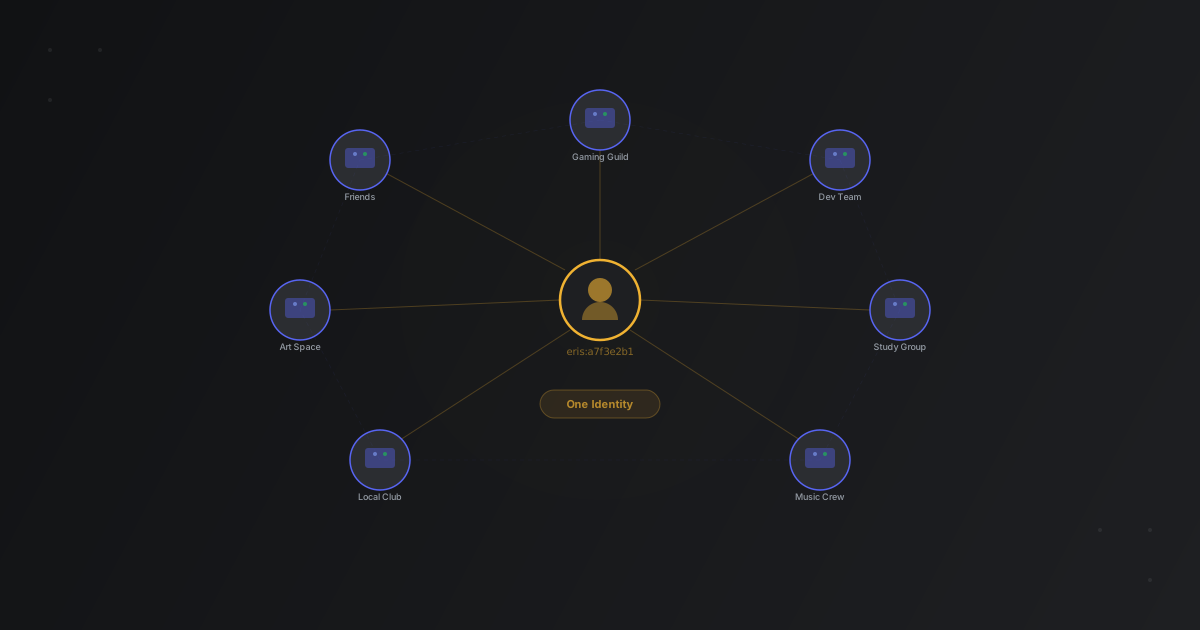
“Federated” is one of those words that sounds important in a pitch deck but doesn’t mean much to most people. So let’s skip the jargon.
You already use a federated system
You have a Gmail address. Your friend uses Yahoo. Your coworker is on Outlook. You email each other without thinking about it.
That’s federation.
Nobody had to “join Gmail” to email you. Everyone picks their own provider — or runs their own server — and the systems just talk to each other because they follow the same protocols.
Now apply that idea to chat. That’s Eris.
How this works in practice
Each community on Eris runs its own guild server. Think of it like a Discord server, except it’s real software running on real hardware that someone in the community actually controls.
The key part: these servers can talk to each other. If you’re on Server A and your friend is on Server B, you can still DM them. No second account needed. Nobody has to switch communities.
The servers verify each other with cryptographic signatures before exchanging anything. It’s not a loose trust system — each server has to prove its identity before communication begins.
Your identity is yours
On Discord, your identity belongs to Discord. They can disable it whenever they want, and you lose everything — your username, your friends list, every server you were part of.
On Eris, your identity is a cryptographic keypair on your device. No company created it, stores it, or can take it away. Your Eris identity looks something like this:
eris:a7f3e2b1That code is derived from your public key. It’s unique to you and mathematically verifiable. When you join a new server, you don’t create a new account — you show up with your existing identity, and the server verifies your key.
What this means in practice: You join a gaming community on one server, a study group on another, and a friend group on a third. All three know you as the same person. Your display name, your reputation, your message history context — it all follows you. Switch servers? Your identity stays the same.
Why this actually matters
Platform lock-in goes away
Ever tried moving a community off Discord? Everyone has to make new accounts, re-add friends, lose message history. The switching cost is so high that most people just stay, even when they’re unhappy.
With federation, moving is easy. Spin up a new server and everyone’s identity works immediately. No signups, no starting over.
No single point of failure
When Discord goes down, every community on the platform goes quiet. Your gaming group, your work chat, your friend server — all offline because one company’s infrastructure had a bad moment.
On a federated network, your server going down doesn’t affect anyone else’s. The rest of the network keeps working.
Nobody owns the network
On a centralized platform, one company decides what’s allowed, what features exist, how much things cost, and who gets banned. On a federated network, each server admin sets their own rules. If you don’t like one server’s policies, take your identity and join a different one — or start your own. There’s no CEO making decisions for everyone.
Cross-server features
Federation opens up things that can’t exist on centralized platforms:
DMs across servers — Message anyone on the network, end-to-end encrypted, without either person joining the other’s server.
Guild discovery — Servers can opt into a federated discovery network. Think of it as a search engine for communities that no single company controls.
Trust verification — Servers perform a cryptographic handshake before exchanging messages. Admins choose which servers to federate with, keeping control over who their community interacts with.
”Isn’t this just Mastodon?”
Different problem. Mastodon is federated social media. Eris is real-time chat: text channels, voice calls, screen sharing, organized communities. The decentralization principle is the same, but the product is closer to “federated Discord” than “federated Twitter.”
Try it out
Your identity is yours. Your community is yours. Your conversations are yours. That’s not marketing copy — it’s a technical property of the system, backed by cryptography and federation.
Open the web app or grab the desktop/mobile app and start chatting.
Want the full protocol details? Check out the architecture docs.
Published February 10, 2025